RPC System (System Tools)
System tools are Python functions that run on a specific cluster node, usually because they need host-level access such as hardware, the OS, or local files. They are exposed over gRPC and called through a central gateway.
The system has three parts:
| Part | Package / service | Role |
|---|---|---|
| Tools RPC SDK | tools_rpc_sdk (src/tools/rpc_sdk) |
Define tools with @register_tool and serve them over gRPC on each node (port 50051) |
| Org RPC Executor | src/tools/org_rpc_executor |
Stores which tool lives on which node (MongoDB), resolves the node IP via Kubernetes, and forwards calls |
| Kubernetes node labels | nodeID=<node_id> |
Map a tool's node_id to a real node |
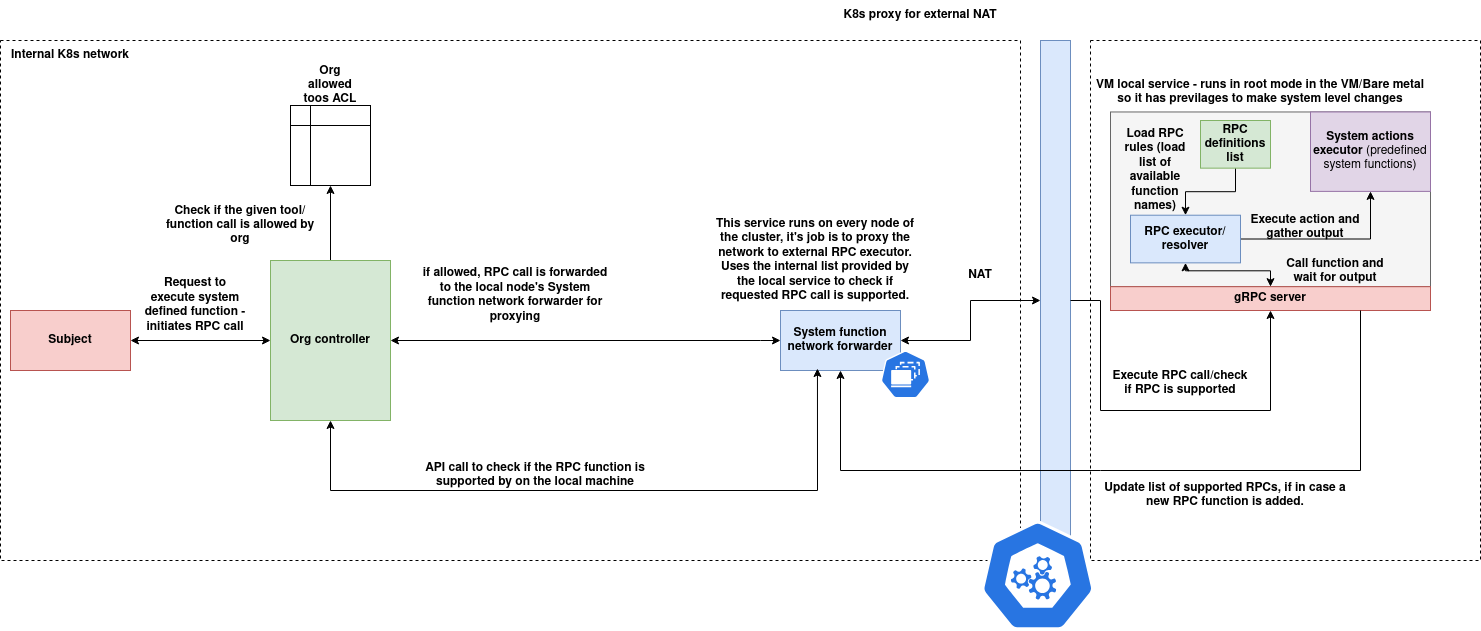
client ──POST /cluster-tools/execute──> Org RPC Executor
                                          │ 1. find (tool_name, node_id) in MongoDB
                                          │ 2. find k8s node with label nodeID=<node_id> → InternalIP
                                          ▼
                                 <InternalIP>:50051  (gRPC ToolExecutor.CallFunction)
                                          │
                                   your @register_tool function
1. Write and serve system tools
Install the SDK
cd functions-tools/src/tools/rpc_sdk
touch README.md          # setup.py reads README.md; the file is not in the repo yet
pip install .
Define tools
A system tool takes bytes and returns bytes. JSON is the usual encoding.
# my_tools.py
import json
import platform
from tools_rpc_sdk.decorator import register_tool

NODE_ID = "node-abc123"   # must match the nodeID label on this node

@register_tool(
    name="reverse_text",
    input_spec={"text": "string"},
    description="Reverses the 'text' field of a JSON payload",
    metadata={"node_id": NODE_ID, "version": "1.0.0"},
)
def reverse_text(input_bytes: bytes) -> bytes:
    data = json.loads(input_bytes)
    return json.dumps({"result": data["text"][::-1]}).encode()

@register_tool(
    name="host_info",
    description="Returns basic host information",
    metadata={"node_id": NODE_ID, "version": "1.0.0"},
)
def host_info(input_bytes: bytes) -> bytes:
    return json.dumps({"hostname": platform.node(), "os": platform.system()}).encode()
register_tool(name, input_spec=None, metadata=None, description="")
| Argument | Notes |
|---|---|
name |
Unique per process. Registering the same name twice raises ValueError. |
input_spec |
Free-form description of the expected input (documentation only). |
metadata |
Put node_id here; it is used when syncing to the Org RPC Executor. All values must be strings, because they are returned in the gRPC map<string,string> metadata field. |
description |
Human-readable summary. |
If the function raises, or returns something other than bytes, the call returns success=false and the error plus traceback in error.
Start the gRPC server
# run_server.py
import my_tools  # importing the module registers the tools
from tools_rpc_sdk.server import serve

if __name__ == "__main__":
    serve(port=50051)
export ORG_SYSTEM_TOOLS_REGISTRY_URL=http://org-rpc-executor:8080   # optional, see below
python run_server.py
# INFO:ToolGRPCServer:Starting ToolExecutor gRPC server on port 50051
On startup, if ORG_SYSTEM_TOOLS_REGISTRY_URL is set, every tool is registered with the Org RPC Executor via POST {url}/tools with this body:
{
  "name": "reverse_text",
  "node_id": "node-abc123",
  "input_spec": {"text": "string"},
  "metadata": {"node_id": "node-abc123", "version": "1.0.0"},
  "description": "Reverses the 'text' field of a JSON payload"
}
If the variable is not set, syncing is skipped and the server still runs.
Duplicate entries on restart
Before re-registering, the syncer tries to delete the old entry at /tools/<name>/<node_id>, but the executor's route is /tools/<node_id>/<name>. The delete fails silently, so each restart adds another copy of the entry. Lookups still work because the first match is used. Clean up with DELETE /tools/<node_id>/<name> if needed.
Run in Docker
The server needs host access, so run it with host networking, one container per node.
FROM python:3.10-slim
WORKDIR /app
COPY rpc_sdk/ /sdk/
RUN touch /sdk/README.md && pip install /sdk
COPY my_tools.py run_server.py ./
CMD ["python", "run_server.py"]
docker build -t node-tools .
docker run --net=host \
  -e ORG_SYSTEM_TOOLS_REGISTRY_URL=http://org-rpc-executor:8080 \
  node-tools
Label the Kubernetes node so the executor can find it:
kubectl label node <k8s-node-name> nodeID=node-abc123
2. Call a tool directly over gRPC
Protocol
syntax = "proto3";
package toolrpc;

service ToolExecutor {
  rpc CallFunction (CallFunctionRequest) returns (CallFunctionResponse);
}

message CallFunctionRequest {
  string tool_name = 1;
  bytes input = 2;                    // raw input bytes
}

message CallFunctionResponse {
  bool success = 1;
  bytes output = 2;                   // raw output bytes
  string error = 3;                   // error message + traceback on failure
  map<string, string> metadata = 4;   // the tool's metadata
}
The generated Python stubs ship with the SDK as tools_rpc_sdk.rpc_service_pb2 and tools_rpc_sdk.rpc_service_pb2_grpc.
Client
# client.py
import json
import grpc
from tools_rpc_sdk import rpc_service_pb2, rpc_service_pb2_grpc

def call_tool(tool_name, payload, target="localhost:50051"):
    with grpc.insecure_channel(target) as channel:
        stub = rpc_service_pb2_grpc.ToolExecutorStub(channel)
        resp = stub.CallFunction(rpc_service_pb2.CallFunctionRequest(
            tool_name=tool_name,
            input=json.dumps(payload).encode(),
        ))
    if not resp.success:
        raise RuntimeError(resp.error)
    return json.loads(resp.output), dict(resp.metadata)

if __name__ == "__main__":
    print(call_tool("reverse_text", {"text": "hello world"}))
    print(call_tool("host_info", {}))
({'result': 'dlrow olleh'}, {'version': '1.0.0', 'node_id': 'node-abc123'})
({'hostname': 'worker-1', 'os': 'Linux'}, {'version': '1.0.0', 'node_id': 'node-abc123'})
3. Org RPC Executor
The Org RPC Executor is the cluster gateway. Clients call it by tool name and node, and it locates and calls the right node.
Deployment requirements
- Runs inside Kubernetes: it loads the in-cluster config at startup and needs RBAC permission to list nodes.
- MongoDB at
mongodb://localhost:27017(currently hard-coded), databasetools_db, collectioncluster_local_tools. Run MongoDB as a sidecar or changeClusterLocalToolsDBdefaults. - Node gRPC servers listen on port
50051.
The package provides two Flask blueprints but no entry point. Mount them in a small app:
# server.py (place next to the core/ package)
from flask import Flask
from core.apis import cluster_tools_bp, tools_executor_bp

app = Flask(__name__)
app.register_blueprint(cluster_tools_bp)
app.register_blueprint(tools_executor_bp)

if __name__ == "__main__":
    app.run(host="0.0.0.0", port=8080)
The examples below use port 8080; use whatever port you choose.
Data model
@dataclass
class ClusterLocalTools:
    name: str
    func: Callable[[bytes], bytes]   # runtime only; never stored
    node_id: str
    input_spec: Dict[str, Any] = field(default_factory=dict)
    metadata: Dict[str, Any] = field(default_factory=dict)
    description: str = ""
A tool is identified by the pair (name, node_id), so the same tool name can exist on several nodes.
API reference
Set GW=http://org-rpc-executor:8080 in the examples below.
| Method | Path | Purpose |
|---|---|---|
| POST | /cluster-tools/execute |
Execute a tool on a node |
| POST | /cluster-tools/resolve |
Resolve a tool's gRPC endpoint (see note) |
| POST | /tools |
Register a tool (used by the SDK sync) |
| GET | /tools/<node_id> |
List tools on a node |
| GET | /tools/<node_id>/<name> |
Get one tool |
| PUT | /tools/<node_id>/<name> |
Update fields |
| DELETE | /tools/<node_id>/<name> |
Delete |
POST /cluster-tools/execute
All three fields are required.
curl -X POST $GW/cluster-tools/execute \
  -H "Content-Type: application/json" \
  -d '{"tool_name": "reverse_text", "node_id": "node-abc123", "input": {"text": "hello world"}}'
input is JSON-encoded to bytes before being sent to the tool. If the tool's output is valid JSON it is decoded, otherwise it is returned as a string.
{
  "success": true,
  "output": {"result": "dlrow olleh"},
  "error": "",
  "metadata": {"node_id": "node-abc123", "version": "1.0.0"}
}
| Status | When |
|---|---|
| 200 | Tool ran successfully |
| 400 | Missing body, or missing tool_name / node_id / input |
| 500 | Tool not registered for that node, node not found in Kubernetes, gRPC failure, or the tool raised. success is false and error explains why. |
POST /cluster-tools/resolve
curl -X POST $GW/cluster-tools/resolve \
  -H "Content-Type: application/json" -d '{"tool_name": "reverse_text"}'
Intended response: {"success": true, "endpoint": "10.42.0.12:50051"}.
Known issue
In the current build this endpoint always returns 500, because it calls the DB lookup with a wrong keyword argument (tool_name= instead of name=). Use /cluster-tools/execute with an explicit node_id, or list a node's tools with GET /tools/<node_id>.
Registry routes
# register manually (same body the SDK sync sends)
curl -X POST $GW/tools -H "Content-Type: application/json" -d '{
  "name": "reverse_text", "node_id": "node-abc123",
  "description": "Reverses text", "input_spec": {"text": "string"},
  "metadata": {"version": "1.0.0"}
}'
# -> 201 {"message": "Tool created", "id": "<mongo id>"}

curl $GW/tools/node-abc123                    # list tools on node
curl $GW/tools/node-abc123/reverse_text       # one tool
curl -X PUT $GW/tools/node-abc123/reverse_text \
  -H "Content-Type: application/json" -d '{"description": "Reverses a string"}'
curl -X DELETE $GW/tools/node-abc123/reverse_text
POST /tools requires name, node_id, and description.
How resolution works
- If
node_idis already cached, use the cached IP and skip the remaining steps. - Otherwise, look up (
tool_name,node_id) incluster_local_tools. If it isn't there, the call fails. - List Kubernetes nodes and pick the one labelled
nodeID=<node_id>. - Take that node's
InternalIP, cachenode_id → ip, and call<ip>:50051.
The cache is never invalidated, so restart the executor if a node's IP changes. Because cached nodes skip step 2, a call for an unregistered tool on a cached node reaches the node, which then returns success=false with Tool '<name>' not found.